.png%3Fw%3D200)
Warehouse Safety Signs: Floor Sign Types Every Facility Should Consider

A warehouse should use clear floor signs to identify stop points, forklift routes, pedestrian crossings, hazards, restricted spaces, emergency equipment, and designated storage areas. The most effective signs appear before workers or equipment operators reach the place where they need to stop, turn, cross, slow down, or keep an area clear.
A good floor-sign system does not mean covering every open space with graphics. It means choosing the right message for each location and giving people enough time to understand and act on it.
In this guide, we’ll cover the floor sign types every facility should consider, where to place them, how large they should be, and when a floor sign, aisle line, or 5S marker is the better option.
Why Floor Signs Matter in a Busy Warehouse
Warehouses bring people, forklifts, pallet jacks, storage racks, inventory, loading zones, and changing work processes together in one environment.
A forklift might approach an intersection while an employee enters from a pedestrian walkway. A pallet may move from storage into temporary staging. Electrical equipment and emergency resources must remain accessible even when floor space is limited.
Visual communication helps make these conditions easier to understand.
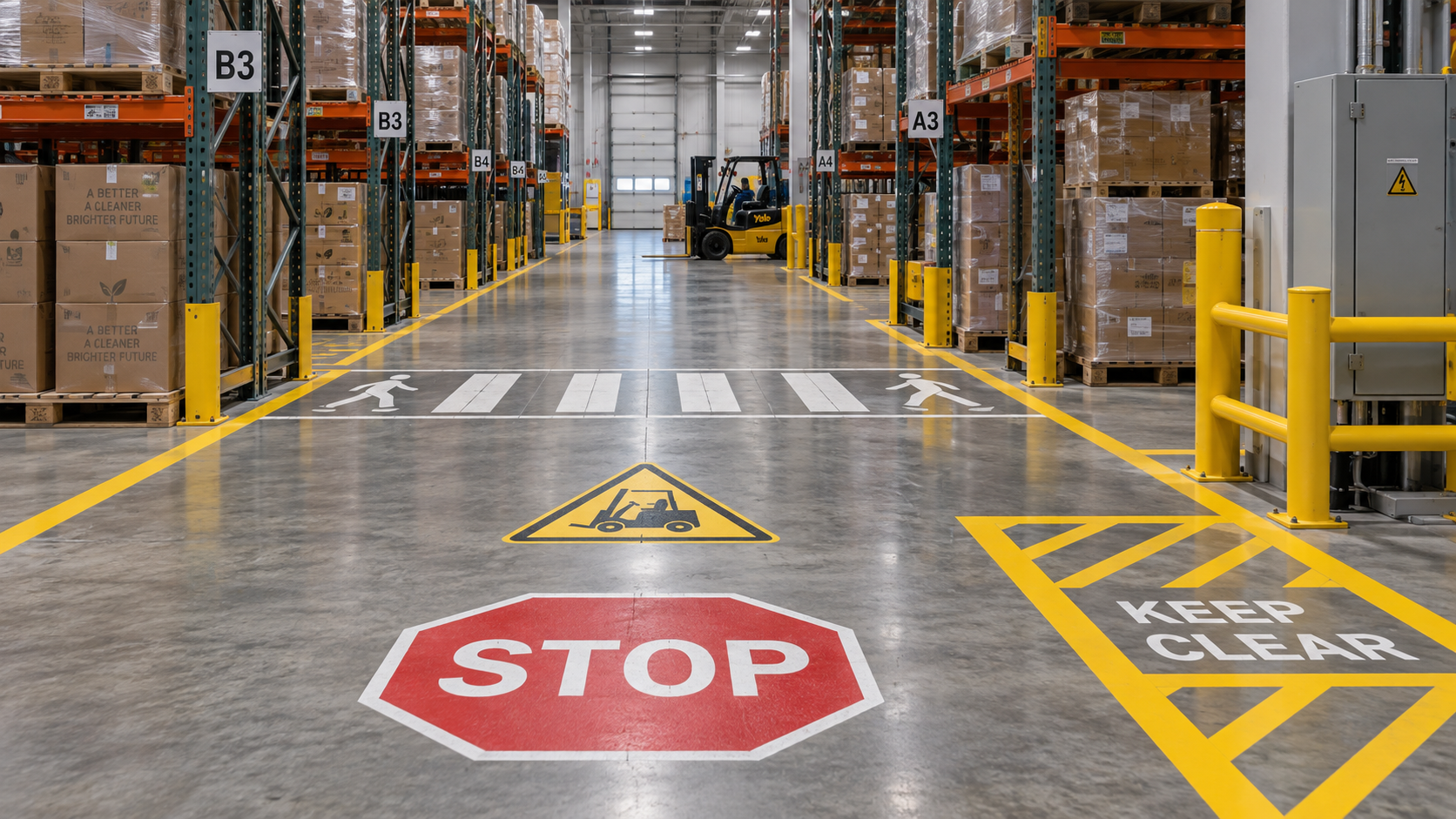
A forklift warning can alert pedestrians before they enter a vehicle aisle. A STOP marker can identify where equipment operators should pause. A KEEP CLEAR message can make an apparently unused area recognizable as protected space.
Floor markings are useful because workers naturally see the floor while walking, driving, loading, staging, and navigating aisles.
The goal is simple: every sign should communicate a useful action at the point where that action matters.
Facilities starting from scratch can browse the FloorSign floor sign collection to compare STOP, forklift, pedestrian, emergency, directional, and keep-clear messages for different areas.
What OSHA Says About Warehouse Aisles and Traffic Areas
Floor markings should support the facility’s actual hazards rather than being installed only because a certain color or symbol looks appropriate.
OSHA’s material handling requirements state that sufficient safe clearance must be available where mechanical handling equipment is used and that permanent aisles and passageways should be appropriately marked.
OSHA also recommends separating lift trucks and pedestrians where possible. Its powered industrial truck guidance discusses pedestrian walkways, barriers, walkway striping, traffic-control signs, mirrors at blind intersections, and other methods for reducing conflicts.
This provides an important planning principle.
A floor sign should be part of a larger traffic-control system rather than the only control used in a problem area.
For example, a forklift warning sign can reinforce a crossing, but a busy intersection may also need walkway markings, stop points, mirrors, barriers, operating procedures, or other controls based on the facility’s conditions.
What Floor Signs Should a Warehouse Have?
The right combination depends on how people and equipment move through the building.
A small stockroom where employees use carts may need only basic directional and organizational markings. A high-volume distribution facility with powered equipment requires a more developed visual system.
The easiest way to decide is to look for repeated decisions.
Where must operators stop? Where do pedestrians cross equipment routes? Which areas tend to become blocked? Where should pallets or carts return after use?
Those questions usually reveal the most useful signs.
Stop Signs
STOP floor signs are useful at intersections, blind approaches, doorways, and locations where traffic needs to pause before moving forward.
Placement is important.
The sign should appear on the approach, not after the operator has already entered the conflict area.
For a clear physical stopping point, FloorSign offers a peel-and-stick Stop Bar floor sign designed for industrial floor use.
Forklift Traffic Signs
Forklift warnings alert pedestrians that powered industrial equipment operates nearby.
Good locations include aisle entrances, loading areas, pedestrian approaches, blind corners, and transitions into mixed-traffic zones.
For example, the Watch for Forklift Traffic floor sign provides a direct warning without requiring employees to interpret a long message.
The sign is only one piece of the solution. Traffic routes and pedestrian movement should still be planned around the conditions in the facility.
Pedestrian Crossing Signs
Pedestrian floor signs help identify where employees on foot are expected to walk or cross.
These markers become stronger when combined with visible walkway boundaries, crosswalk markings, or directional indicators.
The purpose is to make two things clear:
Where should pedestrians move, and where should equipment operators expect pedestrians to appear?
Keep-Clear and Do-Not-Block Signs
Some open spaces are empty because they need to stay empty.
Electrical panels, emergency equipment, doors, exits, and other critical access points can quickly become temporary storage locations during a busy shift.
KEEP CLEAR or DO NOT BLOCK floor signs communicate that the open space is intentional rather than available for another pallet.
Directional Signs
Arrows and wayfinding markers can guide employees toward exits, departments, docks, receiving areas, workstations, and approved travel routes.
They are particularly valuable in large buildings where rows of similar racks can make navigation difficult.
5S Location Markings
5S markers address organization rather than a specific hazard.
They can establish positions for pallets, bins, carts, cleaning equipment, waste containers, tools, and work-in-process materials.
The result is a visible standard for where movable items belong.
Quick Guide to Common Warehouse Floor Signs
| Floor Sign Type | Best Location | Main Purpose | Best Used When |
| STOP | Intersection approaches | Require traffic to pause | A clear stopping point is needed |
| Forklift Traffic | Equipment aisles and shared zones | Warn of vehicle movement | Pedestrians approach lift-truck routes |
| Pedestrian Crossing | Walkways and crosswalks | Define people-focused routes | Pedestrian and vehicle paths meet |
| Keep Clear | Electrical and emergency areas | Prevent obstruction | Access must remain available |
| Directional Arrow | Aisles and route changes | Guide movement | Workers need fast wayfinding |
| 5S Marker | Storage and equipment locations | Define where items belong | Organization is the primary goal |
This table is a starting point. Actual placement should reflect traffic patterns, equipment, visibility, layout, and the facility’s own hazard assessment.
Where Should Warehouse Floor Signs Be Placed?
A useful rule is to position a sign before the person reaches the decision point.
Consider a forklift approaching a cross-aisle.
If the STOP marker appears inside the intersection, the driver receives the instruction at the same place where the conflict may occur.
Moving the marker backward gives the operator time to notice the sign, slow down, stop, check the surroundings, and continue according to site procedures.
Pedestrian warnings work the same way.
A forklift warning positioned on the approach to a vehicle aisle gives employees more useful information than one placed only after they have stepped into the aisle.
High-value locations typically include aisle intersections, blind corners, pedestrian crossings, loading areas, equipment entrances, emergency-access spaces, restricted zones, and staging areas.
Visibility is equally important.
Do not put a sign where pallets, carts, parked equipment, doors, or routine storage constantly hide it. Also emphasizes visibility, organization, employee awareness, and clearly maintained work areas as parts of safer warehouse operations.
Use This 5-Point Floor Sign Decision Check
Before selecting a sign, evaluate the location using five questions.
✅ What is happening here? Identify whether the area is a crossing, forklift route, emergency-access point, storage location, loading zone, or blind intersection.
✅ Who will see the sign? A walking employee views a floor marker differently from an equipment operator approaching at a greater distance.
✅ What action is required? Decide whether the worker should stop, slow down, follow a route, keep clear, cross at a designated point, or place an item in a defined location.
✅ How early should the message be visible? Greater travel speed and longer viewing distance usually call for simpler wording and stronger visibility.
✅ Could normal operations cover the marker? Look at the location when the facility is busy. Pallets, carts, equipment, dirt, wear, or poor positioning can make an otherwise good sign ineffective.
This creates a simple decision sequence:
Situation → Viewer → Required Action → Viewing Distance → Visibility
It is more useful than choosing a sign simply because its color or shape looks appropriate.
How Floor Signs Support Forklift and Pedestrian Traffic
Forklift and pedestrian interaction is one of the clearest examples of why different visual tools should work together.
Imagine a busy aisle intersection.
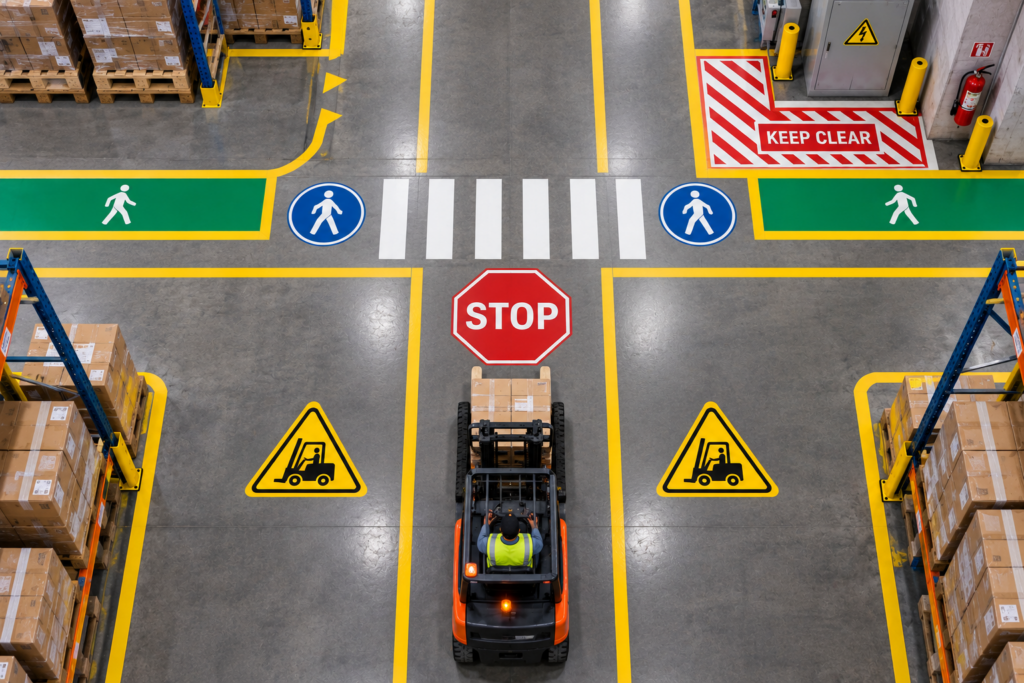
The facility might use solid floor lines to show the vehicle lane, pedestrian markings to identify a walkway, a striped crossing where the two paths meet, and a STOP sign on the forklift approach.
Each marking answers a different question.
The aisle line explains where equipment moves.
The walkway explains where pedestrians belong.
The crossing shows where the routes interact.
The STOP sign explains what the operator should do.
FloorSign’s all floor tape collection can be used to compare solid-color, hazard, anti-slip, center-line, and other tape options when a route or boundary needs to accompany signs.
This layered approach also matches OSHA’s recommendation to use designated walkways, traffic-control signage, and physical separation where appropriate.
Floor Sign, Floor Tape, or 5S Marker: Which Is Best?
Not every floor problem needs another sign.
Choosing the correct visual tool keeps the facility easier to understand.
| Visual Tool | Best Purpose | Example | Choose It When |
| Floor Sign | Communicate an instruction or warning | STOP, FORKLIFT TRAFFIC | Someone needs to know what action to take |
| Floor Tape | Define a route or boundary | Vehicle lane, walkway | Someone needs to know where a zone begins or ends |
| 5S Marker | Define an item’s location | Pallet corners, cart position | Equipment or material needs an assigned home |
| Combined System | Communicate location and behavior | Crosswalk + STOP + lane lines | Several visual cues are needed at one decision point |
The best option is sometimes a combination.
A pedestrian crossing may need walkway boundaries, crossing markings, and a STOP marker.
A storage area may need only location corners because the problem is organization, not hazard communication.
Using 5S Markings for Better Organization
Imagine a staging area intended to hold six pallets.
Without defined positions, the first shift may place them close together. The next shift may spread them across the available floor. Eventually, temporary storage begins creeping toward an aisle.
Location markings create a visible standard.
Employees can immediately see whether a pallet is correctly positioned without measuring distances or asking a supervisor.
The same approach can work with carts, waste bins, cleaning stations, containers, tools, mobile equipment, and work-in-process locations.
FloorSign’s 5S floor markings collection includes angles, arrows, footprints, dots, segments, and other shapes for building defined locations.
For pallet footprints and rectangular storage zones specifically, 5S floor marking corners and angles can provide a cleaner alternative to outlining the entire footprint.
The strongest systems keep the meaning of colors and shapes consistent throughout the facility.
What Size Floor Signs Work Best?
There is no single size that works everywhere.
Choose a sign based on viewing distance, traffic speed, message complexity, available floor space, and surrounding visual clutter.
A compact marker may work well beside a workstation where employees walk slowly and view the sign from close range.
A forklift aisle is different.
An operator is moving while monitoring loads, racks, pedestrians, intersections, and other equipment. A larger sign with a short message may be easier to recognize earlier.
That is also why concise wording matters.
A large STOP symbol is faster to process than a multi-line instruction printed in small type.
When comparing sign sizes, ask whether the person can comfortably identify the message during a normal approach, not while standing directly over it.
Signs for Keep-Clear and Emergency Areas
Protected access areas often benefit from a combination of wording and boundaries.
A KEEP CLEAR message tells employees what action is required. A surrounding border shows how much space should remain open.
This is particularly useful around locations that otherwise look like convenient temporary storage.
The same principle can apply around fire equipment, electrical areas, first aid locations, emergency exits, and other resources that need reliable access.
If the facility needs durable identification around frequently used storage or equipment locations, warehouse floor label protectors are another live FloorSign collection to consider for protecting floor-based labels from normal traffic.
OSHA’s sign guidance also stresses clear, concise wording. That principle is especially relevant on floors because workers often read the message while moving.
Common Floor Sign Mistakes to Avoid
One of the biggest mistakes is solving every visual problem with another sign.
If employees cannot tell where the pedestrian route begins, clearly defined walkway boundaries may be more effective than adding several warning messages.
Another common problem is inconsistent terminology.
Using KEEP CLEAR in one department, NO STORAGE in another, and DO NOT BLOCK somewhere else for equivalent spaces may make the overall system harder to learn.
Wear also matters.
Foot traffic, pallet movement, forklift wheels, dust, cleaning equipment, and daily operations can damage markings. A sign that was obvious when installed may eventually become difficult to recognize.
Include floor markings in routine workplace inspections and check whether they remain readable, visible, correctly located, and relevant to the current layout.
Finally, signs should support training, operating rules, barriers, mirrors, lighting, and other controls rather than replacing them.
How to Audit Your Floor Sign System
A useful audit starts by walking through the facility from several perspectives.
Follow inventory from receiving through storage, picking, staging, and shipping. Then walk the same areas as a pedestrian. Finally, examine major intersections from an equipment operator’s point of view.
At each decision point, determine whether the required action is obvious.
Look at whether the sign can be seen early enough, whether anything normally covers it, whether colors and wording match similar locations elsewhere, and whether a boundary or location marker would communicate the message more effectively.
Taking photos can also help.
A photograph of a busy intersection may reveal visual clutter, damaged markings, inconsistent colors, or a warning that is positioned too close to the actual hazard.
These small observations can make the overall sign system much more useful without adding unnecessary markings.
Final Takeaway: Build a Clear Visual System
A strong warehouse safety plan makes it easier for people to recognize where they should walk, where equipment travels, when they should stop, and which areas must remain open.
Start with the facility’s busiest intersections, shared traffic routes, emergency-access areas, restricted zones, and staging locations.
Then choose each marking according to its job.
Use a floor sign when someone needs an instruction or warning.
Use floor tape when someone needs to understand the boundaries of a route or zone.
Use 5S markers when equipment, pallets, or materials need clearly assigned locations.
The most effective facility is not necessarily the one with the most signs. It is the one where the visual system is consistent enough that workers can understand the next required action quickly.
Frequently Asked Questions
Most warehouses should consider STOP signs, forklift traffic warnings, pedestrian crossing markers, keep-clear signs, directional signs, and 5S location markings. The exact combination depends on how pedestrians, vehicles, equipment, and inventory move through the building. Begin with intersections, shared traffic routes, emergency-access areas, blind approaches, and staging zones where confusion occurs repeatedly. Each marking should solve a specific communication problem rather than simply adding another color or symbol to the floor.
Warehouse floor signs should usually be positioned where workers can see the instruction before reaching the hazard, crossing, restricted area, or decision point. For example, a STOP marker should appear on the approach to an intersection rather than after the operator has entered it. Forklift warnings should give pedestrians advance notice before a vehicle route. Also consider whether pallets, carts, doors, equipment, or temporary storage could cover the sign during normal operations.
The right floor sign size depends on viewing distance, traffic speed, message length, available floor area, and surrounding visual clutter. Smaller signs may work well near slow-moving workstations, while wide forklift aisles and busy intersections can benefit from larger, simpler messages visible earlier in the approach. Short wording, recognizable symbols, and strong contrast are usually more useful than trying to fit detailed instructions into a small floor marker.
Warehouse floor signs improve traffic flow by making stopping points, travel routes, crossings, restricted spaces, and equipment zones easier to identify before workers enter them. Pedestrians can recognize designated routes while equipment operators receive clearer cues about crossings and stopping locations. Signs are most effective when combined with consistent aisle boundaries, training, traffic procedures, and other suitable controls so workers do not have to rely entirely on memory or verbal instructions.